Surron Battery Reviver
A purpose-built bridge and diagnostic system that wakes supported Sur-Ron batteries, reads the data hidden behind the BMS, logs every session, and presents the measured state in a customer-readable recovery workflow.
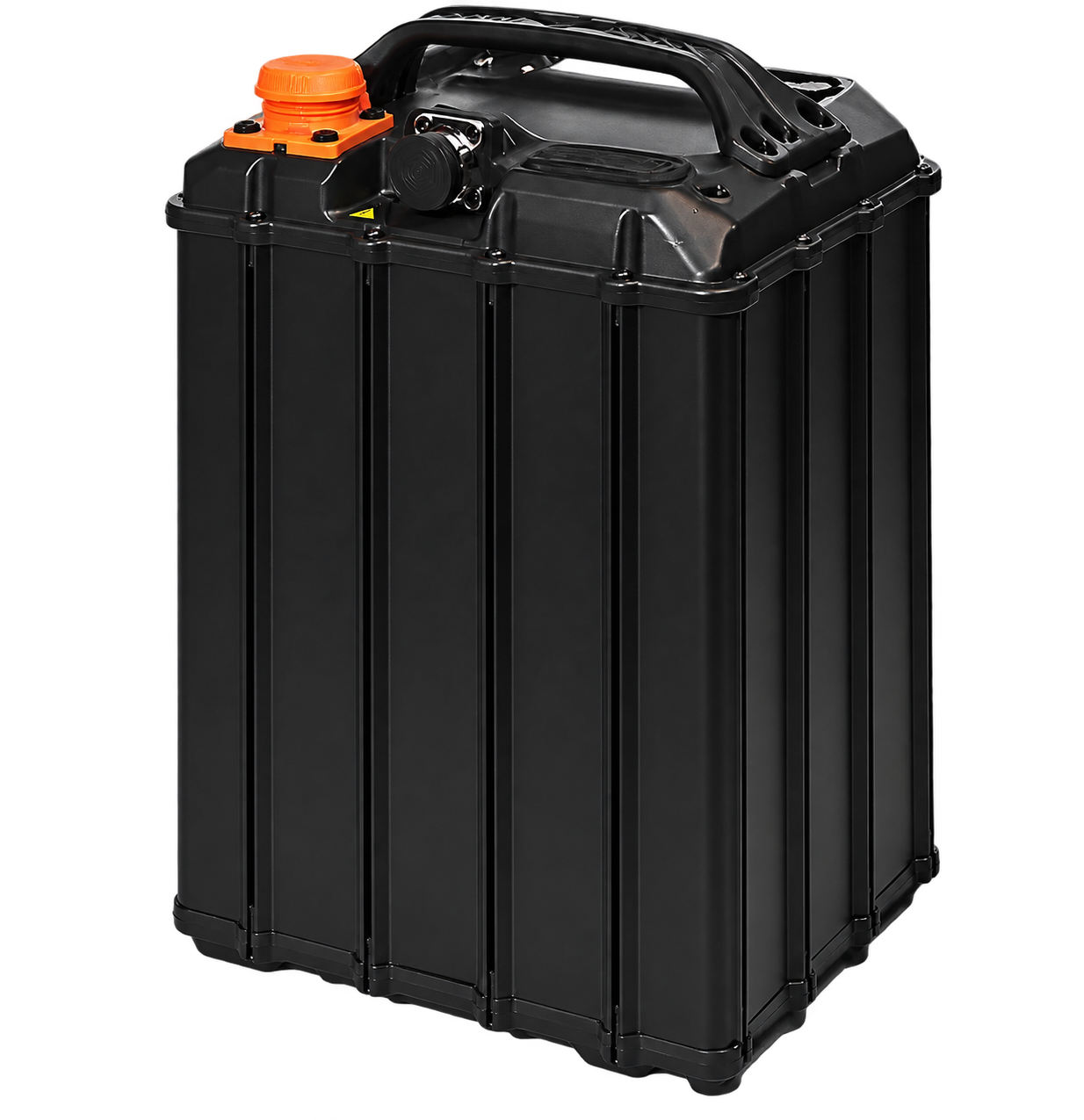
Total pack voltage is not enough when one group can decide whether the original charger starts.
Why I built it
A deeply discharged Ultra Bee pack can still communicate even when it no longer behaves like a normal battery at the charge port. The original charger sees one or more groups below its enable threshold and refuses to start. A voltmeter across the whole pack cannot explain which group is responsible, how large the imbalance is, or whether the reported data is complete.
Very low voltage does not always mean total silence.
In bench testing, I have continued to receive reported group voltages while most groups remained around or above 1 V and the BMS still had enough power to boot and complete the CAN handshake. A handful of groups can report 0 V while the rest of the pack still provides enough power for the BMS to answer.
Below roughly 1 V per group, communication can become less reliable and the diagnostic value collapses. If the BMS never answers, a severely collapsed pack—with many groups potentially near or below 0.5 V—is one possibility, but not the only one. Missing auxiliary power, wiring or connector faults, a sleeping or failed BMS, and CAN faults can look identical from outside.
No handshake means no trustworthy diagnosis—not proof of one exact internal voltage. Whatever the cause, the prototype can display a reported group below 2.00 V for diagnosis while blocking recovery. That block is a conservative product-control policy, not proof that a cell above it is safe.
I wanted one tool that could establish CAN communication, show the evidence, preserve raw logs, teach a first-time user what the numbers mean, and keep the dangerous decisions visibly separate from the visual design.
What I built
Hardware and software that communicates with supported battery variants, tracks live RX/TX activity and exposes the battery state to the interface.
A dependency-free interface for phone, tablet and desktop with Basic, Advanced and Technician views.
Twenty groups for supported Ultra Bee packs and 22 for the confirmed Light Bee 2 pack, with incomplete data kept visibly incomplete.
Individual-cell charting, pack voltage, current, temperatures, event records and CSV export for later comparison.
Support for older 4-pin Ultra Bee charge connectors and newer 6-pin Ultra Bee / Light Bee 2 variants.
Interrupting acknowledgements, model-specific complete-snapshot requirements, stale-data treatment and a conservative prototype recovery block below 2.00 V pending formal review.
From prototype electronics to a real product
I am developing two enclosure directions around the display sizes that have worked best during prototyping: a wide 3.49-inch touchscreen and a compact 2.06-inch square AMOLED. The screens are large enough to keep the weakest cell, delta, temperature and the primary action visible without turning the device into another phone-sized computer.
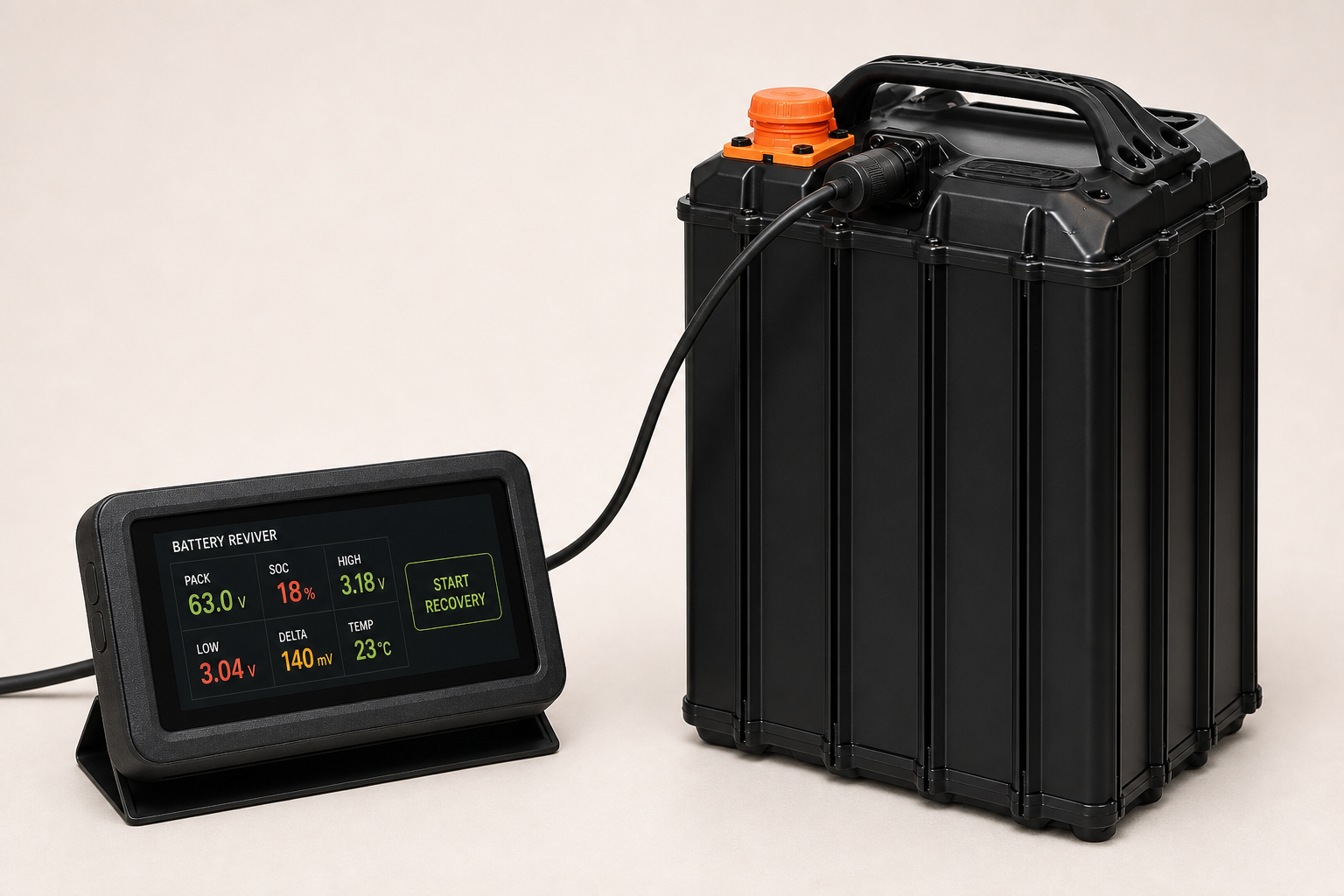
The hard part was not the graph
The difficult work was learning which CAN behavior was observed, which decode was provisional, and which data was still unknown. The interface keeps those evidence levels intact. A badge cannot become “confirmed” because a different color looks cleaner.
The BMS wake and output authorization behavior also demanded a defensive connection sequence: request a short wake, explicitly release it, then watch fresh state and current before enabling controls. If the browser or phone disappears, the next connection begins by requesting Latch OFF again.
Important: this is not a blind charger or a BMS-bypass tutorial. The system is designed to keep diagnosis visible even when recovery is blocked. The prototype currently blocks recovery below 2.00 V as a conservative control policy; this is not proof that a reported group above 2.00 V is safe to recharge.
Supported launch targets
- Sur-Ron Ultra Bee, 2024 and earlier — 4-pin charge connector
- Sur-Ron Ultra Bee 2025 and early 2026 — 4-pin charge connector
- Sur-Ron Ultra Bee mid-year 2026 — 6-pin charge connector
- Sur-Ron Light Bee 2 (LB2) 2026 — 6-pin charge connector
What comes next
The immediate work is the sellable enclosure, final bridge hardware, production provisioning, authenticated cloud history, field testing across connector variants, and a launch-quality support workflow. The web interface is already functioning against the local live bridge and storing real session logs.
Sur-Ron is the first supported platform, not the final one. Additional electric-motorcycle and powersports battery families remain future work. Each model will need independent connector mapping, wake-behavior validation and repeatable CAN or RS-485 decoding before it is presented as supported.